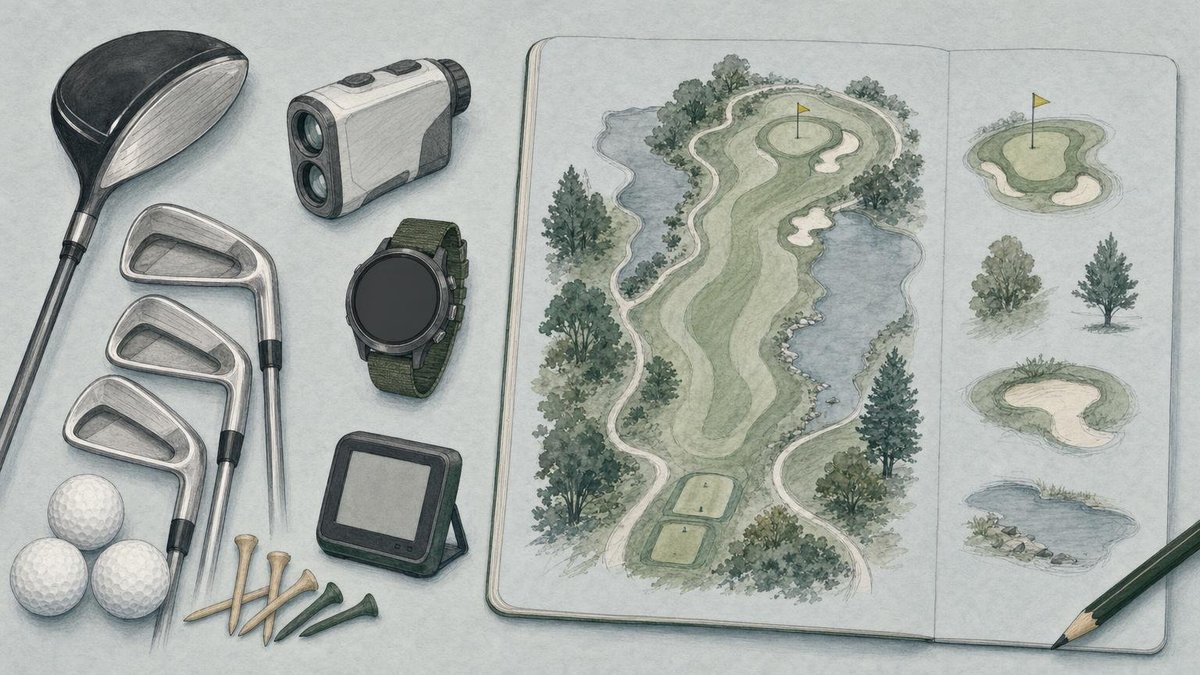
Every January the PGA Merchandise Show in Orlando fills a convention center with drivers that promise more distance than last year’s drivers, which promised more distance than the year before. If every claim were true, tour players would be hitting it 500 yards. The golf gear trends that matter are quieter than the ads, and a few of them really do change how a round goes.
This page sorts golf tech worth the money from the rest by one test: is it worth the money for someone who plays once or twice a week? Some golf gear is, some of it is a nice extra, and some of it is marketing.
The gear trends worth paying for
Custom fitting comes first
The single best equipment spend for most golfers is a fitting, not a club. A fitter with a launch monitor matches shaft, loft and lie angle to your swing, and the result is often a bigger improvement than any new model. The big brands (TaylorMade, Callaway, Titleist, Ping) all sell through fitters, and many shops take the fitting fee off the price if you buy. Get fitted, then decide whether you need new clubs at all.
Forgiving drivers and irons
The clearest equipment trend of recent years is forgiveness. Drivers marketed around a high moment of inertia, often called 10K drivers after the number on the spec sheet, twist less on off-center hits, so a miss still goes reasonably straight. Carbon-fiber crowns and faces save weight that designers move low and back in the head. Callaway has used AI-designed faces since 2019, shaped so that mishits lose less ball speed. For irons, the same idea shows up as hollow bodies and tungsten weighting, which give a blade-like look with more forgiveness.
None of this makes last year’s club bad. A fitted driver from two or three seasons back is a better buy than an unfitted new one, and it costs much less.
Golf tech worth the money on the course
Rangefinders and GPS watches
If you buy one piece of golf tech, buy something that gives you the real distance. A laser rangefinder from Bushnell, Garmin or Nikon measures to the flag; a GPS watch from Garmin or Shot Scope gives the front, middle and back of the green and the distance to hazards without pointing anything. Laser is more precise to the pin, GPS is faster and shows what you cannot see. Slope functions adjust for uphill and downhill shots, but must be switched off in competition.
This is the clearest example of golf tech worth the money: most amateurs come up short of the green far more often than they go long, and a real number fixes that.
Shot tracking
Sensors that screw into the grip end of each club, such as Arccos, or a watch-and-tag system from Shot Scope, record every shot without you writing anything down. After a dozen rounds they show where strokes are lost, and the answer is rarely the driver. Arccos needs a subscription for its full statistics, so count that in the cost.
Tech trends for practice and the garage
Personal launch monitors
Ten years ago a launch monitor meant a fitting studio. Now units such as the Garmin Approach R10 and the Rapsodo MLM2PRO sit behind the ball on the range for a few hundred dollars and report carry distance, ball speed and launch angle. They are good for learning exactly how far each club carries, which is the knowledge most golfers lack. Spin numbers on the cheaper models are less reliable, and a premium unit like a SkyTrak or a camera-based monitor adds simulator play for home use.
Worth it if you practice regularly. If you go to the range twice a summer, a rangefinder will do more for your scores.
Electric push carts and simulators
Electric carts that follow you or run by remote, from makers like Stewart Golf and MGI, make walking eighteen holes easy on the back. They are expensive, but on a walking-only course they earn their keep. Home simulators and simulator bars are the other fast-growing corner of golf; if you live somewhere with a short season, an indoor bay keeps a swing in shape through the winter.
Golf gear that is not worth the money yet
Some purchases are better skipped. Yearly driver upgrades without a fitting are the biggest waste. Premium tour balls lose their advantage for players who do not generate tour-level spin, and a mid-priced ball often suits an average swing better. Training aids that promise a new swing in a week rarely deliver it, and a lesson usually costs less.
Golf balls deserve a separate word, because they are the one piece of golf gear everyone buys again and again. A ball fitting, which many shops now offer with a launch monitor, takes ten minutes and often points to a cheaper ball than the one you were playing. Pick one model and stick with it for a season: a consistent ball makes every distance you learn more reliable.
The test for any of the golf gear trends above is simple: does it tell you something true about your game, or does it promise to change your game for you? The first kind is worth the money. Before buying anything for a trip, check what the course allows; some of the top 10 public golf courses in the US are walking only, which makes a light bag or a push cart worth more than another club.
Questions golfers ask
What is the golf tech most worth the money for an average golfer?
A rangefinder or a GPS watch, followed by a proper club fitting. Knowing the real distance to the flag saves more strokes for a mid-handicap golfer than any new driver, and a fitting makes sure the clubs you already own suit your swing.
Are personal launch monitors accurate?
The ones that sit behind the ball and use radar or cameras are accurate enough for practice and gapping, especially for carry distance and ball speed. Spin figures are less reliable on the cheaper units. For a final club fitting, a fitter's studio monitor is still the better tool.
Can you use a rangefinder in a tournament?
Distance-measuring devices are allowed under the Rules of Golf when the committee adopts the local rule, which most amateur events do. The slope function, which adjusts for elevation, must be switched off in competition.
Should you buy a new driver every year?
No. The gains from one model year to the next are small for most golfers. A driver fitted to your swing, even an older model, beats an unfitted new one, and last year's model usually costs far less once the new one arrives.