The sign by the first tee at Bethpage Black warns golfers off in plain words: an extremely difficult course, recommended only for highly skilled players. People line up for it anyway, some of them overnight in their cars. That is the thing about the best public golf courses in the US. Nobody checks your handicap at the gate, and the price of a round ranges from a state-park fee to more than a week of groceries.
The ten below are public golf courses you can play without knowing a member. A few belong to resorts that hand their best tee times to hotel guests, and the list says where that applies. The order of this top 10 is not a score; it runs roughly from the Pacific to the Atlantic, with a detour to Wisconsin.
How the top 10 were picked
Every course in the top 10 sells tee times to the public, has a record of hosting a major championship or a top amateur event, or shows up near the top of the national public-course lists from Golf Digest and Golfweek. Price was not a filter, which is why Pebble Beach is in and why the list does not pretend to be a budget guide. If you want something shorter and cheaper first, the par 3 guide covers short courses at several of the same resorts.
The best public golf courses in the US, coast to coast
1. Pebble Beach Golf Links – Pebble Beach, California
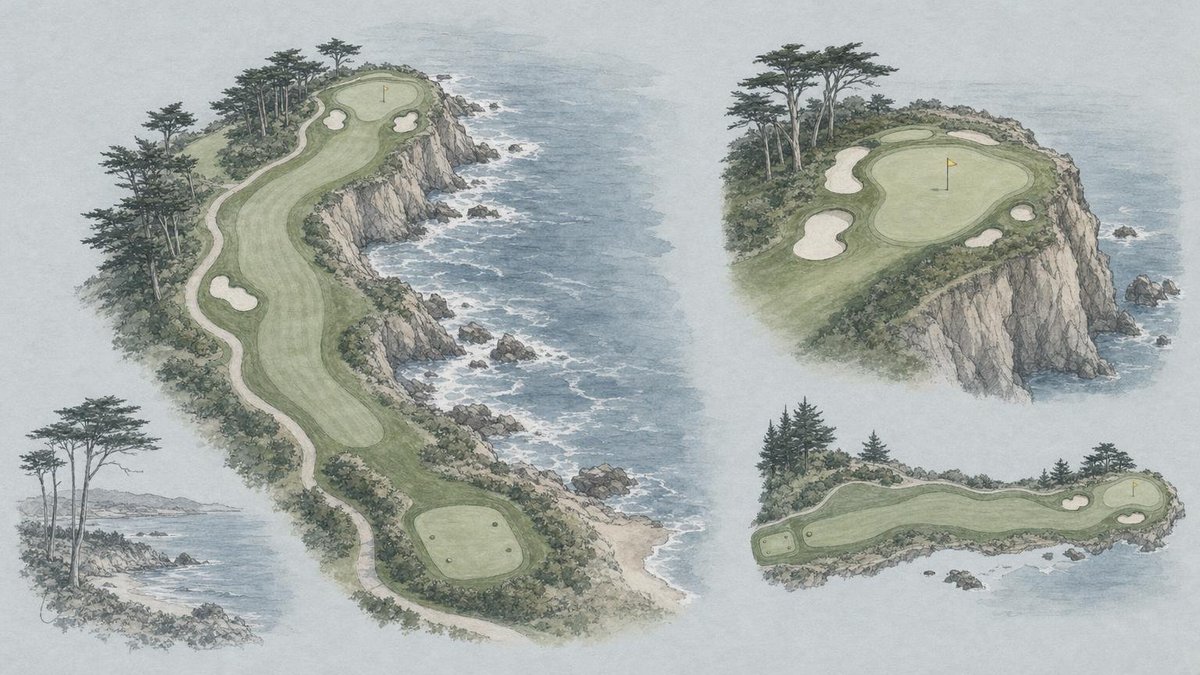
Pebble Beach has hosted the U.S. Open six times, most recently in 2019, and it is booked for the championship again in 2027. Stand on the 7th tee once and the reputation makes sense: a short par 3 dropping toward a green with the Pacific on two sides. The green fee is well above $600, and guests of the Lodge or the Inn at Spanish Bay get priority on tee times. Outside players can still get on, mostly by booking close to the date and staying flexible. The resort also runs The Hay, a nine-hole par 3 course redesigned by Tiger Woods, for a fraction of the price.
2. Pacific Dunes – Bandon, Oregon
Tom Doak’s course at Bandon Dunes Golf Resort opened in 2001 and has been near the top of every public ranking since. It runs over bluffs and through dunes above the ocean, and the fairways play firm, so the ball keeps rolling and the wind decides how far. Bandon is walking only, with caddies available, which suits the place. Most visitors stay several nights and play the resort’s other courses too.
3. Bethpage Black – Farmingdale, New York
The Black is owned by New York State and run by the state parks office, which is why a course that hosted the U.S. Open in 2002 and 2009, the PGA Championship in 2019 and the Ryder Cup in 2025 costs New York residents far less than a private club would. Visitors pay more and have a shorter booking window. Expect long carries over rough, deep bunkers, and no carts on this course.
4. TPC Sawgrass, Stadium Course – Ponte Vedra Beach, Florida
Pete Dye’s Stadium Course is the home of The Players Championship every March, and the island green at the par 3 17th is one of the most photographed holes in golf. It is open to public play, with tee times easier to get when staying at the resort. Plenty of good golfers have hit three balls into the water at 17 and called it a fair price for the story.
5. Pinehurst No. 2 – Pinehurst, North Carolina
Donald Ross shaped No. 2 over decades, and Bill Coore and Ben Crenshaw restored its sandy waste areas and wiregrass in 2010 and 2011. The domed greens are the point: miss by a few feet and the ball runs off into a collection area. Pinehurst hosted the U.S. Open in 2024 and is set to host it again repeatedly in the coming decades. Access to No. 2 runs through the resort.
6. Whistling Straits, Straits Course – Haven, Wisconsin
Another Pete Dye design, built on flat land along Lake Michigan and shaped to look like Irish links. It hosted the PGA Championship in 2004, 2010 and 2015 and the Ryder Cup in 2021, which the United States won 19–9. The course has more than a thousand bunkers, and walking with a caddie is the rule on the Straits. The resort is run by Kohler, which owns the nearby American Club hotel.
7. Torrey Pines, South Course – San Diego, California
A city-owned municipal course on the cliffs above the Pacific, home to the PGA Tour’s annual Farmers Insurance Open. Tiger Woods won the 2008 U.S. Open here in a playoff with a broken leg, and Jon Rahm won the 2021 edition with birdies on the last two holes. San Diego residents pay a fraction of the visitor rate, and visitors who want a weekend morning should plan well ahead.
8. Erin Hills – Erin, Wisconsin
Wide fairways, long fescue and big rolling ground left behind by glaciers. Erin Hills hosted the 2017 U.S. Open, which Brooks Koepka won, and the 2025 U.S. Women’s Open. It is walking only, and from the back tees it is very long, so pick a set of tees honestly.
9. Chambers Bay – University Place, Washington
Chambers Bay sits in a former gravel quarry on Puget Sound and is owned by Pierce County. It hosted the 2015 U.S. Open, won by Jordan Spieth, and the fine fescue playing surfaces make it play like a links. The routing climbs and drops more than most walkers expect, and the course is walking only. The US golf events calendar covers the tournaments that still move around the country like this one did.
10. The Ocean Course at Kiawah Island – Kiawah Island, South Carolina
Pete Dye again, finished in time for the 1991 Ryder Cup and set right on the Atlantic with no wind protection at all. Rory McIlroy won the PGA Championship here in 2012, and Phil Mickelson won it in 2021 at 50, the oldest major champion in history. The resort gives its guests priority, and the course is no easier on a calm day than most courses are in a gale.
Playing public golf courses in the US without overpaying
Most of these public golf courses you can play have two prices: one for residents or resort guests and one for everyone else. At the municipal courses (Bethpage, Torrey Pines, Chambers Bay) the gap is big, and visitors book later. At the resort courses the green fee is high for everyone, and a stay on site buys earlier tee times rather than a discount.
A few practical points help. Twilight rates at the municipal courses can cut the fee sharply if you can finish before dark. Walking-only courses still rent push carts or offer caddies, and the caddie fee and tip come on top of the green fee. The club membership guide is worth a look if you find yourself paying daily fees at the same course every week, because a seasonal plan can work out cheaper.
The best public golf courses in the US are also the most popular, so midweek in shoulder season is the easiest time to get on. Pinehurst in late autumn and Bandon in early spring are both good bets, if you bring a rain jacket for Bandon.
Questions golfers ask
What makes a golf course public in the US?
A public course sells tee times to anyone, with no membership required. That covers city- and county-owned municipal courses, privately owned daily-fee courses and resort courses. Some resort layouts reserve most tee times for hotel guests, so public does not always mean easy to get on.
Which is the best public golf course in the US?
Pebble Beach Golf Links is the usual answer, and it is hard to argue with the stretch from the 6th to the 10th along the cliffs. For pure golf many players would pick Pacific Dunes in Oregon, which costs less and plays firmer and more varied.
Are municipal courses among the best public golf courses in the US?
Yes. Bethpage Black is run by New York State Parks and Torrey Pines by the City of San Diego, and both have hosted the U.S. Open. Residents of the state or city pay far less than visitors at both.
How far ahead should you book a famous public course?
As early as the booking window opens. At resort courses that window is longer for guests staying on site. At busy municipal courses, residents get the first chance, and visitors take what is left, often a week or less ahead.