At Augusta National, the day before the Masters starts, the best players in the world spend the afternoon on a nine-hole course where no hole is longer than a wedge or a short iron. Their children caddie, somebody makes a hole-in-one, and nobody minds that the winner has never gone on to win the Masters the same week. The Par 3 Contest says something true about golf: the short holes are where the fun is.
Par 3 golf courses in the US have moved from the edge of the game to the center of it. Every big new resort now opens a short course alongside its championship layouts, and city par 3s that were built decades ago are busy again. This guide covers what a par 3 golf course is, how it differs from the courses around it, and which ones in America are worth a trip.
What is a par 3 golf course?
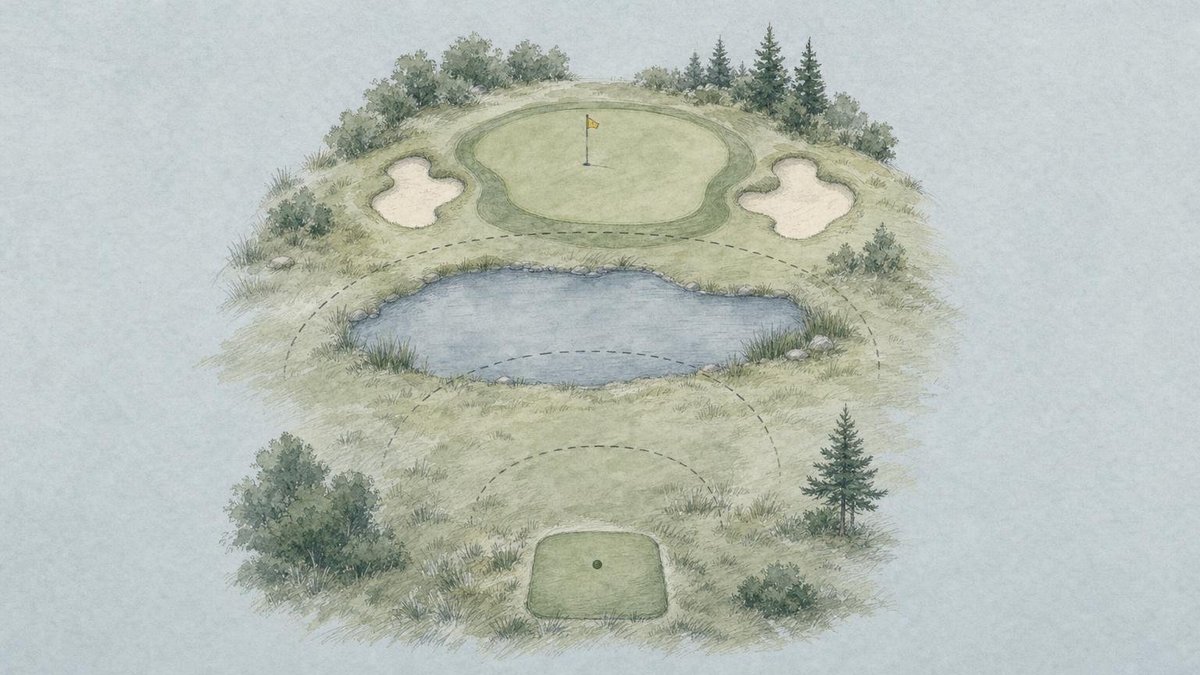
So here is what a par 3 golf course is, in plain terms: a course where every hole is a par 3. You hit one shot to reach the green and, in theory, two putts finish the hole. The holes usually run from under 100 yards to around 200, so a nine-hole par 3 course can fit on the land of a few full-size holes.
Three kinds share the name, and they play differently:
- Par 3 courses. Every hole a par 3, nine or eighteen holes, par 27 or 54. The classic city short course.
- Pitch and putt. Very short holes, often under 100 yards, played with a wedge and a putter.
- Short courses at resorts. A newer kind, built as a design piece in its own right. Holes can be as short as 40 yards or as long as 150, greens are big and wild, and the score is beside the point.
An executive course is not quite the same thing. It mixes par 3s with some par 4s, so it needs a few more clubs. If the scorecard adds up to more than 54 for eighteen holes, you are on an executive course.
The best par 3 courses in America
The list of the best par 3 courses in America has changed fast. Ten years ago it would have been mostly a handful of city courses; now it is led by resorts that spent real money on design. These are the ones that justify planning a trip around them.
The Hay – Pebble Beach, California
Nine holes on the hill above the Pebble Beach Lodge, redesigned by Tiger Woods and reopened in 2021. The holes are short, from about 30 to 100 yards, and one of them copies the 7th hole on Pebble Beach Golf Links, the most famous short par 3 in the country. For the price of a round, it is by far the cheapest way onto the property, and there is a putting course and a bar next to it. The full course is on the list of the top 10 public golf courses in the US.
Top of the Rock – Ridgedale, Missouri
Jack Nicklaus designed this nine-hole par 3 course at Big Cedar Lodge, on a ridge above Table Rock Lake in the Ozarks. It became the first par 3 course to host a professional tournament round when the Bass Pro Shops Legends of Golf, a PGA Tour Champions event, played here. Come for the views at sunset, and expect a fair few holes over water.
Bandon Preserve – Bandon, Oregon
Thirteen par 3s by Bill Coore and Ben Crenshaw, set in dunes above the Pacific at Bandon Dunes Golf Resort. Net revenue from the course goes to a conservation group working on the southern Oregon coast. The wind matters more here than the yardage on the card, and a 9-iron one day becomes a 5-iron the next.
The Cradle – Pinehurst, North Carolina
Gil Hanse built nine holes in about 789 yards at Pinehurst Resort, and it opened in 2017. Music plays from speakers, people carry a drink and a couple of clubs, and the greens are hard enough that good players still walk off annoyed. It sits a few minutes’ walk from the clubhouse at Pinehurst No. 2.
Palm Beach Par 3 – Palm Beach, Florida
Eighteen holes owned by the Town of Palm Beach, squeezed between the Atlantic and the Intracoastal Waterway, with several holes right on the ocean. Raymond Floyd redesigned it. It is one of the few short courses with a full eighteen holes and genuine variety in length, and the ocean holes are as pretty as any on the Florida coast.
The Sandbox – Sand Valley, Wisconsin
Seventeen short holes by Coore and Crenshaw on the sand barrens of central Wisconsin. The number of holes is not a typo. Sand Valley is a walking resort, and The Sandbox is where groups end up after a full round, playing for drinks until it gets dark.
A guide to your first round on a par 3 course
Most people in the US who try golf for the first time try it on a range. A par 3 course is a better place to start, because you hit shots with consequences: a green to find, a ball to finish. The etiquette is the same as on any course, with one advantage: groups behind you will wait less, because nobody spends long on a par 3.
The rest of this guide comes down to one habit: take fewer clubs than you think. Four or five is plenty, and carrying a light bag keeps the round moving. Pay attention to the pin position as well as the yardage; on short holes a back pin can add a club. The season board is a reminder that the Masters Par 3 Contest falls in April, which is also when most northern short courses reopen.
Good players use par 3 courses differently. A short course is the cheapest serious practice in golf, because every shot is a scoring shot. Playing with a single club, or two balls from each tee, turns a nine-hole loop into an hour of short-game work that no driving range can copy.
How to find par 3 golf courses near you in the US
The best par 3 courses in America are destination trips, but most short-course golf happens close to home. City parks departments run many of the par 3 golf courses in the US, often on land too small for a full course: Los Feliz in Los Angeles and Harvard Gulch in Denver are two long-running examples. Driving ranges sometimes add a lighted par 3 loop, and private clubs increasingly add a short course for members’ families.
Three things are worth checking before you go. First, whether the course takes tee times or works first come, first served. Second, whether it rents clubs, since many do. And third, whether it is lit, because a lighted par 3 course in summer turns a weeknight after work into a round of golf.
For children, the usual way in is First Tee, the youth program the World Golf Foundation started in 1997. It runs through local chapters across the country, and many of them teach on short courses and nine-hole layouts, because a par 3 hole is one a ten-year-old can actually reach in a shot or two. Chapters usually supply clubs for their classes, so a family can find out whether golf sticks before buying a junior set.
Questions golfers ask
What is par on a par 3 golf course?
Every hole is a par 3, so par is 27 for nine holes and 54 for eighteen. Some short courses that call themselves par 3 courses slip in a short par 4 or two, which pushes the total up slightly; the scorecard will say.
How long does a round on a par 3 course take?
Much less than a regular round. Nine short holes with no long walks between them often take around an hour for a group that keeps moving, though a busy weekend evening at a popular course can stretch that.
Which clubs do you need for a par 3 course?
A putter, a sand wedge, a pitching wedge and two or three irons or hybrids cover most short courses. Drivers stay in the car. Many courses rent half sets, and some resort short courses are designed around a wedge and a putter.
Are par 3 golf courses good for beginners?
They are the best place to start. The holes are short enough to reach the green, the rounds are cheap and fast, and nobody behind you is waiting to hit a driver. Good players use them too, because the short game is where most strokes go.
What is the difference between a par 3 course and an executive course?
A par 3 course has only par 3 holes. An executive course is mostly par 3s with some par 4s and occasionally a par 5, so it plays longer and needs a few more clubs, but still takes less time than a full-length course.